Welcome to this blog post I’m sharing another update from the latest modules of my MA in Performance practices at ArtEz University of the Arts in the Netherlands. This task has involved making a portfolio object that “should document and disseminate the core aspects of your practice-as-research in a creative yet rigorous way to the audience of your field of specialization, who are not familiar with your work.
My cosmic kaleidoscope artefact documents and disseminates a core aspect of my practice-as-research – multiplicity. I am an older feminist artist who works with four alter-egos, in the kaleidoscope I bring elements and traces of them together, they tumble, blend, separate, constantly re-arranging and multiplying.
The object mirrors my research, where I bring the alter-egos together to explore how they relate to each other, how they develop, operate and what performance possibilities they might generate. That’s at the heart of my research question.
The cosmic kaleidoscope is a machine for optical multiplicity and a precise metaphor for my research. It generates multiple imperfect reflections, through rotations and framing, it makes ever changing constellations that are never resolved into a single image. There is no original image, as I argue, there is no original self, only shifting relations.
As an embodied device, the kaleidoscope works like my alter-ego practice, it is an assemblage, a collection of mirrors, card, tube , light , traces and elements of the alter-egos, and a viewing body looking through it. The images in the kaleidoscope only exist when an eye aligns with the device and moves it. Looking through it is a micro‑performance of multiplicity.
At first it looks like a simple construction – it’s made from a cheap accessible pringles pack – but nothing in my practice is straightforward. Seventeen packs of pringles later. One of the most important materials are the mirrored aspects, the image multipliers, on the outside of the piece, they are not clear or straightforward reflections, there are over 3000 tiny tiles that fracture and distort images, the interior reflectors uses vinyl (like this material used in the display) that blurs and distorts the image.
I like the weight of the tiles on the tube, you feel the edges of the tiles, I hope the roughness communicates the human (home-made nature of it) in a non-human object. It’s not a toy; it is playful but there is substance. There’s a radiance to it, it’s intentionally attractive, part of the addressivity – I want you to hold it and engage.
But it’s not a perfect version, in a toy you would get random but brilliant geometric shapes, if this kaleidoscope were like that it wouldn’t fit the practice (I have learned how to make a version like that but that’s not my intention.) Mariella, my tutor, asked me what the Kaleidoscope does? What is its purpose for the research practice? So yes it’s a multiplicity machine but the kaleidoscope as a whole operates as a container that makes it possible for the merging / blurring / freeing, tumbling, to happen and to be seen and reflected on – in a way that up til now, that hasn’t really happened before.
To get this action I had to enlarge the chamber that holds the elements has been enlarged and I haven’t stuck anything down. In fact, I would have loved to have made the kaleidoscope longer – there are assignments size constraints - and if I had the skills / time to be able to make it extendable, merge the concept with the telescopic, I think that would have been brilliant, extending the imagination and possibilities.
There are strong links to the field and the theory here, I’m seeing it as a portable heterotopic device, (after Foucault) the kaleidoscope temporarily suspends everyday perception and offers viewers a direct, sensorial encounter with visual multiplicity. I wanted it to invite you to experience, rather than simply read about, the unstable, relational nature of identity that my practice seeks to foreground.
To illustrate the difference, between reading about and experiencing the kaleidoscope, I wanted to show you an earlier prototype, this version has the score and the information on the outside. I rejected that idea, finding it not as inviting visually – and as you start reading, you are in your head, experiencing it differently. Distracting and somewhat distancing, it affects how you engage with and approach the object.
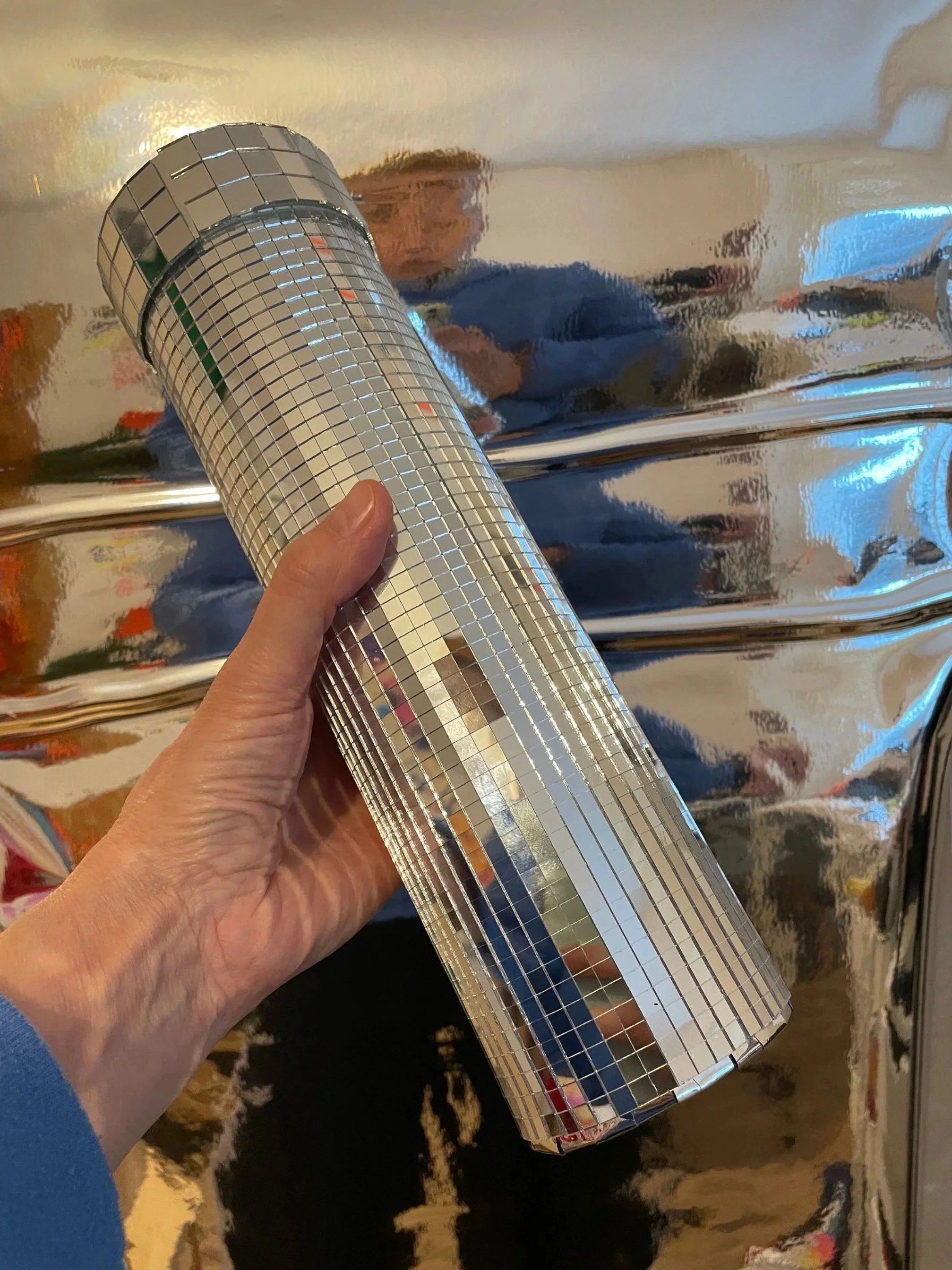
This version is less didactic, I feel that as soon as you pick it up, you’re immediately in it, and exploring for yourself. And while I’m thinking about the impact of the addressivity - Another key feature - Some forms of the kaleidoscope shape the lens so you only see what’s in the mirrored frame, with mine, I kept this open, so you see some of the environment context – it’s a space within a space. how it is staged with the mirrored vinyl means you can always see yourself, and you can also remove the lens and extend see yourself multiplied.
Each alter‑ego is folded into the object: it looks to the cosmos with Doris*, (includes some fragments of one of her cosmic maps)
It invites child‑like play with The Little One, (there’s her dice) – and it is playful.
It fractures and distorts images in the spirit of Donnah anger – there are words from her poems, and a lock of hair is in there, and it only produces change through controlled movement, echoing Tatyana’s choreographic labour – and her elements include metal pin) .
And partial images of them are in there. Illustrating photos and drawings.
As a result of the specialisation, I’m adopting new methods that help contain and learn about the relationality (this is in the essay below, where there’s also more on the theoretical connections) but I mention the specialisation here, as it represents a commitment to the messy reality, the chopped up nature, the traces, becoming super important. I was inspired by Anne Juren’s index approach to her practice, and by Xavier Le Roy’s choreography in his work Retrospective. Both are methods that I will be using in the next steps of my research, and I’ve translated to the making of the kaleidoscope, it specifically informs my decision-making around which traces and elements to include in the lens.
The kaleidoscope comes with a card that helps to contextualise the portfolio, it introduces the alter-egos, invites the audience to engage with and enact elements of my practice – as you’ll read in other blog posts below there is more context and references to a range of documentation tools and practices that include video film work, photography, writing – text, poetry and a script, drawings, sounds and playlists, costume, objects and artefacts, collected over the last 6 years.
While there is extensive documentation, as yet the organisation of the archive as a whole is a work in progress. What is nice is that the archive -whilst it’s messy like the practice– it feels alive. Every time I make a performance experiment, I, and others – are re-engaging with archive, it grows and changes as it accumulates. That’s my main form of dissemination at this point (I also share work on social media, again, it’s primarily targeted at my existing networks of artist / researchers), and I am thinking more about how I move forward.
So finally, I love the analogue qualities – but I have aligned my phone to the viewing hole / eye to show readers of this blog a few of the images from both the prototypes and the final kaleidoscope. Thanks for your interest.